Researcher Story
Making Online Polls More Trustworthy with AI
Polls shape how governments, companies, and the public understand public opinion, but the methods behind them are under strain. U.S. telephone-survey response rates fell from roughly 36% in 1997 to approximately 3% in 2023. The groups that stop responding are not a random sample of the population, which can introduce bias into survey results.
Much of the polling field has moved online, where responses are less expensive and easier to collect. However, online participation introduces another challenge: when anyone can access a poll, it can be difficult to determine whether each participant was eligible to respond.
A conventional solution is to place a central authority in charge of verifying eligibility, similar to the identity-verification methods used by electronic voting systems. Although this approach can work, it introduces additional friction and privacy concerns while reducing some of the openness that makes online participation attractive.
Amr Akmal Abouelmagd, working with faculty advisor Dr. Amr Hilal, is investigating whether the structure of social interaction can help enforce eligibility without relying on a central authority.
In their approach, a poll spreads peer to peer through a real social network. Each participant is asked to forward it only to people who meet the eligibility requirements, although not every participant follows that rule. The researchers record only the pattern of who forwarded the poll to whom—not the content of anyone’s response.
Graph neural networks are then trained on the resulting dissemination graph to identify participants who should not have been counted. Improper forwarding leaves structural traces in the graph, and the model learns to recognize those patterns.
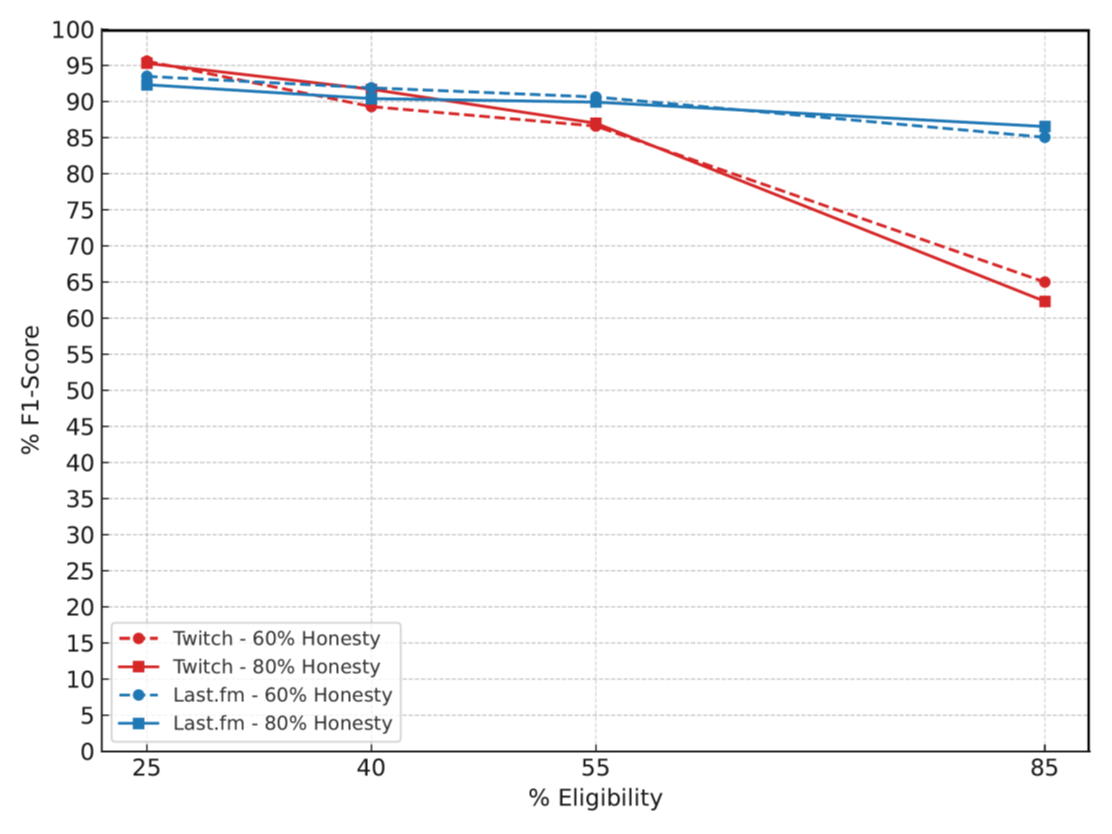
The researchers tested the method using two real social networks: a Last.fm graph containing approximately 465,000 nodes and a Twitch graph. The experiments examined different assumptions about participant honesty, eligibility, and the share of users who initially received the poll.
The method maintained an F1 score above 80% when the eligible share of the population was 55% or lower, and accuracy exceeded 90% in some configurations. The resulting paper was accepted at CSCI’25.
How RCD Supports the Research
These experiments were too large to run on a personal computer. The Last.fm network alone contains approximately 465,000 nodes and more than four million edges.
Each experimental configuration required the researchers to simulate poll dissemination across the complete graph, calculate centrality measures to select root nodes, generate Node2Vec random walks over the network, and train a GraphSAGE model on the results.
The full study repeated this process for 32 combinations of dataset, eligibility ratio, root-node share, and honesty level. RCD’s computing and memory resources made it possible to run this experimental grid and, when a design decision changed, repeat the complete sweep rather than retaining only the first results the researchers could afford to produce.
Research Team
Amr Akmal Abouelmagd
M.S. Student
Department of Computer Science
Dr. Amr Hilal
Faculty Advisor
Department of Computer Science
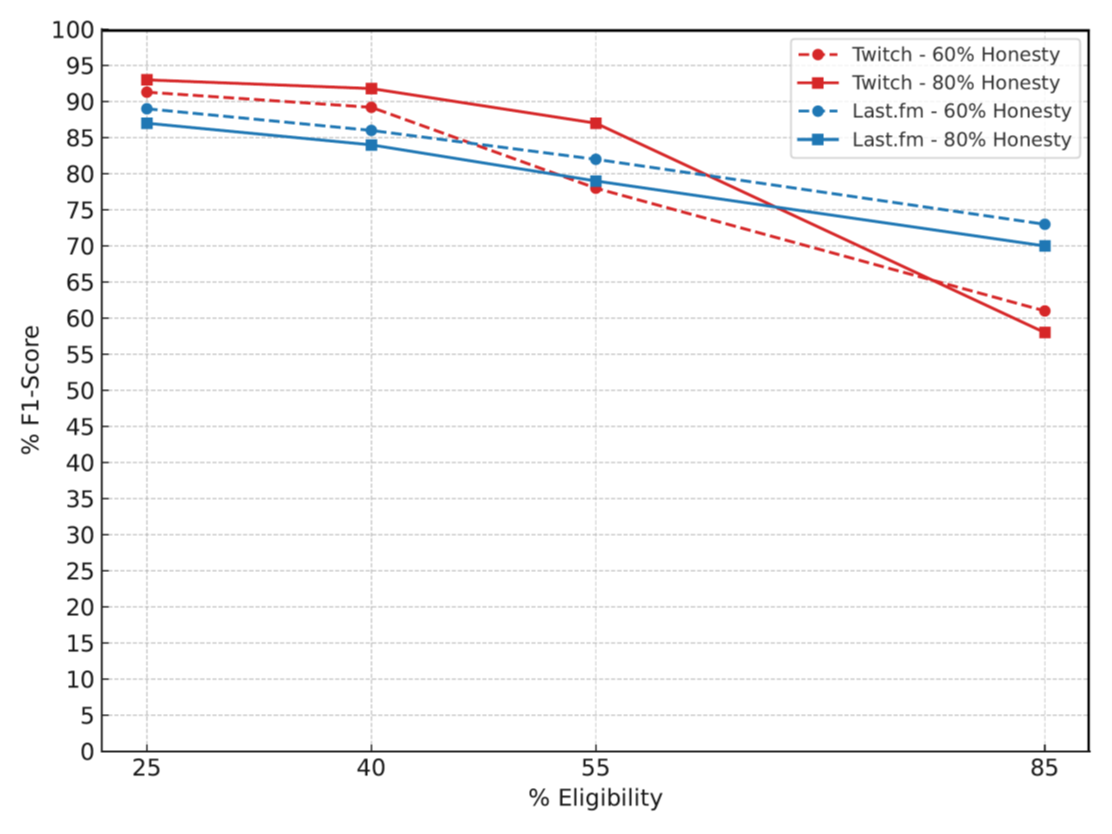
Model F1 scores across eligibility and honesty levels when 1% of participants serve as root nodes for poll dissemination. Results are shown for the Twitch and Last.fm social-network datasets.