RCD-supported Projects at Research and Creative Inquiry Symposium 2026
The following is a list of research projects that used the services offered by Tennessee Tech’s Research Computing and Data department (RCD). Here we’ve listed the title, authors, advisors, location on the RCI Day 2026 map, and abstract for each project.
Look for this RCD tag while walking the floor to see the impressive projects we’ve helped:
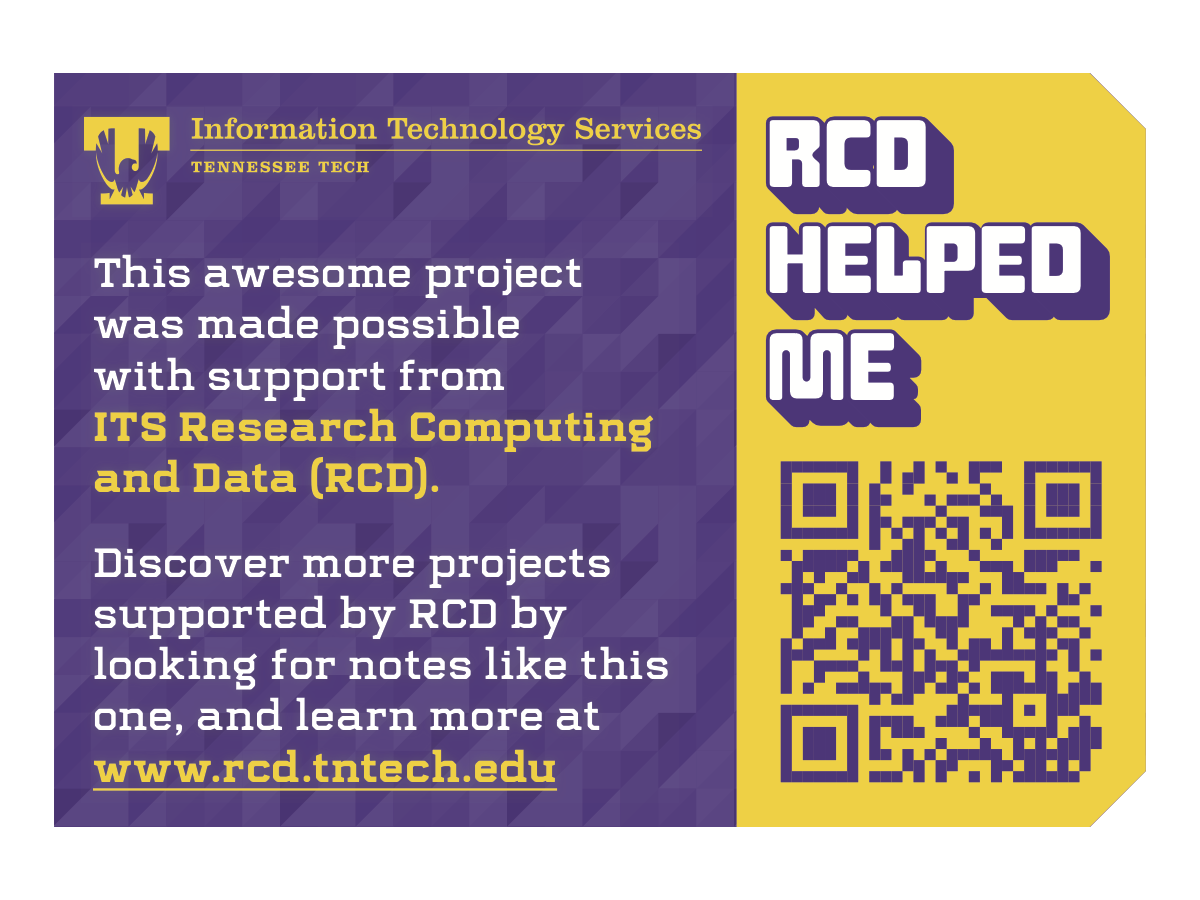
If you think RCD could help with your research needs, or would like to discuss the services we offer, you can find a short summary of who we are, what we do, and what resources we have here. Please also feel free to schedule a meeting with one of our crew to discuss how we can help.
Projects that RCD helped:
- Evolutionary Mechanisms Shaping Chromosome Architecture in Fusarium
- Lineage-specific Dynamics of Telomere-targeted MoTeR Elements and Structural Variation in the Host Diversification of Magnaporthe oryza
- Functional Analysis of Silent Information Regulator 2 (SIR2) in Pyricularia oryzae
- Creation of a Taxonomic Database of Arthropods in Subterranean Environments in the Bridgestone/Firestone Wilderness Area of Tennessee
- JNK3 Inhibition and Possible Alzheimer’s Treatment
- Molecular Docking, Pharmacophore Modeling, and Quantum Mechanical Analysis of Methylxanthine Binding to the Adenosine Receptor
- Physicochemical Kmer Encoding for the Enhanced Evaluation and Expansion of Artificial Intelligence Protein Structural Prediction Models
- Nitrate Reduction to Ammonia for Renewable Energy Storage and Wastewater Remediation
- Comparison of Single-Atom Alloy (SAA Pt-Ir) with Single-Atom Catalyst (SAC Pt and SAC Ir) for Sustainable Hydrogen Production from Ammonia
- Multimodal Machine Learning for Student Retention Prediction: Integrating Temporal, Textual, and Tabular Features
- Seeing the Spark Before the Flame: Wildfire Risk Detection via UNets
- Reward-Guided Fine-Tuning of Language Models with Social Feedback
- The Evolution of U.S. Artificial Intelligence Policies: A Comparative Analysis of Federal and State Legislative Trends
- Next-Generation Robotic Platform for Multimodal Radiation Detection and Emergency Response
Evolutionary Mechanisms Shaping Chromosome Architecture in Fusarium
Authors: Salimi, Sahar
Advisors: Mostafa Rahnama
Location: ASC-62
Click here for abstract
Abstract: The genus Fusarium comprises ecologically diverse filamentous fungi that include major plant and animal pathogens. One interesting observation is the association with horizontally acquired accessory chromosomes (ACs) and host-specific virulence. Although it plays a central role in shaping genomic architecture and virulence among species, karyotype evolution—changes in chromosome number, structure, and organization—remains poorly characterized in Fusarium. In this study, we investigate genome and karyotype evolution in Fusarium through comparative genomics, synteny analysis, and structural variant profiling using genomes from a set of species representing the breadth of phylogenetic diversity within the genus. Our work focuses on detecting and validating chromosome fusion and fission events, identifying conserved syntenic blocks, and examining the contribution of centromere dynamics and transposable elements to chromosomal rearrangements. Preliminary evidence from published Fusarium genomes indicates substantial variation in genome size, GC content, and TE composition, reflecting repeated cycles of genome expansion and compaction. Such processes, coupled with inter-centromeric recombination and segregation errors, are likely major drivers of karyotypic[RP1.1]. By integrating structural variation with phylogenetic analyses based on single-copy genes, we aim to elucidate evolutionary relationships that are not adequately resolved by sequence-based phylogenies alone. This research will generate a comprehensive assessment of chromosome-level evolution in Fusarium, providing insights into how genome dynamics influence adaptation, pathogenicity, and speciation. Understanding the mechanisms underlying karyotype diversification in Fusarium will not only enhance evolutionary and genomic frameworks for this complex genus but also support improved strategies for managing Fusarium-related diseases in agriculture and public health.Lineage-specific Dynamics of Telomere-targeted MoTeR Elements and Structural Variation in the Host Diversification of Magnaporthe oryza
Authors: Astha Mishra
Advisors: Mostafa Rahnama
Location: ASC-63
Click here for abstract
Magnaporthe oryzae is a filamentous ascomycete that infect more than 50 grass species and causes major diseases such as rice blast and wheat blast. Genomic plasticity in this species is tightly linked to transposable elements (TEs), which are highly enriched in subtelomeric regions that harbor diverse avirulence genes. Previous population-level studies have shown that TE insertion polymorphisms shape gene gain and loss, regulatory diversification, and the emergence of host-specialized lineages. Here, we focus on a family of telomere-targeted non-LTR retrotransposons known as MoTeRs (Magnaporthe oryzae Telomeric Retrotransposons). These elements are known to destabilize chromosome ends, promote ectopic recombination, and drive rapid evolution of subtelomeric sequences. To examine how MoTeRs activity and structural variation (SV) contribute to host diversification, we analyzed complete M. oryzae genome assemblies from eight host-specialized lineages. We found that Triticum- and Lolium-associated lineages show pronounced MoTeR accumulation at chromosome ends despite having lower genome-wide TE content. These lineages also exhibit a reduced overall SV burden compared with high-TE lineages, suggesting more localized rather than genome-wide structural remodeling. Mapping MoTeRs-associated SVs identified 81 Magnaporthe Effector Protein (MEP) genes impacted by rearrangement, linking MoTeR activity directly to effector diversification. Finally, analysis of Illumina assemblies from 29 additional lineages revealed strong lineage-specific patterns of MoTeR expansion and contraction across the species complex. Together, these findings support a model in which MoTeR-driven telomere instability and subtelomeric SVs generate highly dynamic genomic niches that facilitate effector diversification and contribute to the evolution of multiple host-specialized lineages within M. oryzae.Functional Analysis of Silent Information Regulator 2 (SIR2) in Pyricularia oryzae
Authors: Ari Mortensen, Justin King, Sahar Salimi, Astha Mishra, Mostafa Rahnama
Advisors: Mostafa Rahnama
Location: ASC-64
Click here for abstract
Silent Information Regulator 2 (SIR2) is a conserved NAD⁺-dependent histone deacetylase that plays a central role in telomere maintenance, heterochromatin formation, and transcriptional silencing. Despite its importance in model organisms, the function of SIR2 in filamentous phytopathogenic fungi remains largely unexplored. Here, we investigated the biological role of SIR2 in Pyricularia oryzae, the causal agent of rice blast disease. Deletion of SIR2 resulted in striking developmental and pathogenicity defects: the mutant exhibited a severe reduction in conidiation and complete loss of virulence, which we found to be caused by the failure of conidia to germinate. Transcriptome analysis revealed widespread gene-expression alterations in the sir2 mutant, with strong enrichment for subtelomeric and stress-responsive genes. In parallel, chromatin profiling revealed marked changes in the distribution of the activating histone mark H3K27ac, indicating that SIR2 is required to maintain proper epigenetic landscapes at telomeric and gene-regulatory regions. Consistent with this, multiple subtelomeric gene clusters became aberrantly activated, suggesting a breakdown of telomere-proximal silencing normally maintained by SIR2. Moreover, genes involved in conidiation, germination, and early infection stages showed pronounced expression changes, reflecting the broad regulatory disruption caused by loss of SIR2 rather than simple repression. These chromatin and transcriptional abnormalities point to a global loss of epigenetic stability, potentially altering higher-order chromosome organization and telomere-associated regulatory circuits. Together, these findings demonstrate that SIR2 is essential for fungal development, chromatin integrity, and infection capability. Our study strengthens the broader understanding of how telomere-linked chromatin regulation influences genome function and pathogenicity in P. oryzae.Creation of a Taxonomic Database of Arthropods in Subterranean Environments in the Bridgestone/Firestone Wilderness Area of Tennessee
Authors: Emmy Easterwood, Zoe Wills
Advisors: Carla Hurt
Location: ASC-69
Click here for abstract
Subterranean cave ecosystems harbor unique biological communities characterized by specialized adaptations. However, these ecosystems are highly vulnerable to human disturbance, making biodiversity assessments essential for conservation. Environmental DNA (eDNA) metabarcoding is a powerful tool for surveying vertebrate and macroinvertebrate communities in caves and karst systems. However, the effectiveness of eDNA surveys depends on the availability of comprehensive genetic reference libraries that link eDNA sequences to known species. This project will address this gap by generating a reference library for cave and karst arthropods in the Cumberland Plateau. Specifically, the development of genetic databases for 16S and COI barcodes from arthropods collected at cave eDNA sampling sites. These barcodes will be linked to voucher specimens, providing valuable taxonomic information for cave biodiversity studies. Findings from this study will enhance the accuracy of eDNA metabarcoding for assessing biodiversity and community composition in subterranean habitats and support conservation policies aimed at protecting cave ecosystems in the Cumberland Plateau.JNK3 Inhibition and Possible Alzheimer’s Treatment
Authors: Aiden Wallace
Advisors: Derek Cashman
Location: ASC-85
Click here for abstract
The research I have been working on is for how specific compounds bind to and interact with the JNK3 and MKK complexes in a possible treatment for Alzheimer’s disease. This has been done by using programs such as Alpha Fold and MOE to create 15 compounds and simulate the docking interactions of these compounds with JNK3 and MKK. I then compared the docking habits of these compounds in 5 different docking models. These models were created with the use of Alpha Fold. After this a comparison of what residues where binding occurred was made and the top 3 compounds that had the best binding characteristics were taken and refined further to increase their binding affinity. The main purpose of this research is to investigate JNK3 receptor inhibition and its application for possible treatment for Alzheimer’s. Several compounds show promise due to their high affinity binding with JNK3 in a possible use for Alzheimer’s treatment and are being looked into further. This research is still ongoing and will hopefully bear fruit in addressing the challenges that are associated with the treatment of Alzheimer's disease.Molecular Docking, Pharmacophore Modeling, and Quantum Mechanical Analysis of Methylxanthine Binding to the Adenosine Receptor
Authors: Jeffrey Snyder
Advisors: Derek Cashman
Location: ASC-91
Click here for abstract
This study focuses on computational explorations into methylxanthines, including caffeine, theobromine, and theophylline, in combination with interactions of the adenosine receptor by combining molecular docking with ab initio quantum mechanical analysis. Regarding ligand recognition, minor consideration was given to the consensus amino acid sequence of adenosine receptors and their relationship to potential binding sites. Using MOE 2024 and Gaussian 16, each ligand was docked into the receptor active site, generating five low-energy conformations ranked by binding Gibbs free energy (ΔG, kcal/mol). Quantum mechanical calculations were performed using G16 at the B3LYP/6-31G level of theory to evaluate electronic structure and density functional theory. The HOMO and LUMO orbitals were calculated to identify regions of electron donation and acceptance. Pharmacophore models were derived from docking to assess orbital distribution and binding interactions. Noncovalent contributions to ligand receptor stability (London dispersion forces and electrostatic interactions) were defined by Coulomb’s law and analyzed. This study aims to demonstrate the correlation between electronic structure, ligand binding behavior, and differences among methylxanthines and their influence on receptor affinity. The results will include five docked confirmations, ligand interaction maps, HOMO and LUMO maps, quantum mechanical calculations, and various insights into receptor affinity.Physicochemical Kmer Encoding for the Enhanced Evaluation and Expansion of Artificial Intelligence Protein Structural Prediction Models
Authors: Christopher Hardy
Advisors: Derek Cashman
Location: ASC-95
Click here for abstract
The accuracy of artificial intelligence protein structural prediction models often relies on the evaluation of genetic context found within the intra- and inter-sequence relationships of multiple sequence alignment (MSA) files. However, depending on a protein’s family and the relevance of its constituent domains, sequence databases may produce sparse results for an MSA query. Additionally, the complex deep learning architectures used to interpret MSA files can obscure the exact nature of internal amino acid relationships resulting in a black box. Instead of forgoing MSA-based models, we propose a machine-learning based data pipeline for the refinement and human-interpretable evaluation of MSAs generated by two popular protein structural prediction models, AlphaFold and RoseTTAFold. For contrast, we compared our approach to workflows utilizing the MSA-free models OmegaFold and ESMFold. Within the pipeline, each sequence within an MSA is organized into overlapping contiguous fragments (termed Kmers) that are arranged according to a predetermined set of physicochemical values. Then, standard vector similarity and statistical metrics are used to evaluate various intra and inter-sequence relationships in a human-interpretable manner. Current results suggest that this novel pipeline is useful for both evaluating the quality of MSAs and for exploring the energetic and conformational spaces of various proteins. While the accuracy of the individual protein predictions was often similar between all four tested models, the inclusion of an MSA within AlphaFold’s and RoseTTAFold’s inference processes provides researchers an opportunity that overshadows the potential downfalls that models like OmegaFold and ESMFold are attempting to circumvent.Nitrate Reduction to Ammonia for Renewable Energy Storage and Wastewater Remediation
Authors: Ekele Dinneya-Onuoha
Advisors: Ali Estejab
Location: ENG-173
Click here for abstract
Ammonia is increasingly recognized as a next-generation energy vector because it can transport hydrogen in a stable, carbon-free form while also serving as an essential industrial commodity. Yet conventional ammonia synthesis remains resource-intensive, prompting strong motivation for alternative, sustainable pathways. One promising route is the electrochemical conversion of nitrate (an increasingly pervasive contaminant from agricultural runoff and industrial discharge) into ammonia. This approach not only recovers value from a harmful pollutant but also creates a platform for storing renewable electricity in chemical form. Electrochemical nitrate reduction offers a sustainable alternative by enabling simultaneous green ammonia production and remediation of nitrate-polluted wastewater. However, achieving high selectivity and reaction rates requires an understanding of how catalyst surfaces mediate each elementary step of the multi-electron nitrate-to-ammonia pathway. Kinetic insight is therefore essential for identifying the factors that control activity and guide the design of more efficient electrocatalysts. This study delivers a computational analysis of nitrate reduction on Pt (111) surfaces. Platinum is examined because it remains one of the most active and well-characterized metal catalysts for multi-electron nitrogen-oxygen transformations, providing a reliable benchmark for mechanistic analysis. Using density functional theory and transition-state searches, we evaluate adsorption energies, activation barriers, and elementary-step rate constants for all relevant intermediates. The results reveal the dominant reaction pathways, rate-determining steps, and the influence of surface structure on ammonia formation. We present mechanistic insights while positioning the work within our broader research effort that integrates computational predictions with experimental validation to advance electrochemical nitrate-to-ammonia conversion for renewable-energy storage.Comparison of Single-Atom Alloy (SAA Pt-Ir) with Single-Atom Catalyst (SAC Pt and SAC Ir) for Sustainable Hydrogen Production from Ammonia
Authors: Yulieth Mercado, Emily Taylor
Advisors: Ali Estejab
Location: ENG-175
Click here for abstract
As global energy demands shift away from limited and polluting fossil fuels, hydrogen has emerged as a critical clean energy carrier. Ammonia (NH3) presents a promising solution for hydrogen storage and transport, particularly because it can be recovered from wastewater, providing an avenue for both environmental remediation and energy production. However, the efficiency of extracting hydrogen through ammonia electrolysis depends heavily on the catalyst used. This research contributes to broader goal of using multiscale modeling to evaluate how these catalysis alter reaction kinetics and solvation free energies, ultimately aiming to optimize industrial electrolyzer design. This study utilizes Density Functional Theory (DFT) through the Vienna Ab-initio Simulation Package (VASP) to perform geometry optimizations and calculate the adsorption energies of NH3 and its dissociation products (NH2, NH, and N). Performing geometry optimizations on two single-atom alloys (SAA) 1)a 4-layer Platinum-Iridium with a single Ir atom (Pt-Ir) surface and 2)a 4-layer Iridium surface with a single Pt atom (Ir-Pt) and compare the results with two single-atom catalysts (SAC) of 3)Pt and 4)Ir. This study identifies the most stable adsorption sites, specifically top, bridge, and hollow positions, for ammonia and its dehydrogenated intermediates. The calculated adsorption energies on these surfaces provide the essential foundation for determining reaction thermodynamics in the presence of solvent and electric field effects. These atomic insights are vital for refining the solvation free energy models, moving closer to the development of highly efficient catalysts for green hydrogen production from ammonia.Multimodal Machine Learning for Student Retention Prediction: Integrating Temporal, Textual, and Tabular Features
Authors: Kashaina Nucum
Advisors: William Eberle
Location: ENG-199
Click here for abstract
Student retention remains a significant challenge in engineering programs due to academic rigor and structural barriers. At Tennessee Technological University’s College of Engineering, approximately 20% of students do not persist beyond their first year, highlighting the need for early identification of at-risk students to enable timely, targeted interventions. This work addresses two key research questions: (1) which academic, demographic, and advisement-derived features most strongly influence retention predictions at the individual level, and (2) which factors are broadly associated with attrition across the student population to inform institutional planning and evaluation. To support these goals, we present a web-based tool for predicting first-semester, first-year, and multi-year retention. The system integrates socio-demographic attributes, academic performance indicators, and advisement notes as predictive features. Advisement notes are analyzed using Aspect-Category Sentiment Analysis, leveraging a combination of rule-based methods, sentence-transformer embeddings, zero-shot inference, and a RoBERTa-based sentiment classifier. These NLP-derived features are combined with structured data in a hybrid modeling framework, using XGBoost for short-term predictions and a bidirectional LSTM for multi-term forecasting. Model interpretability is incorporated through SHAP, enabling identification of the most influential factors driving retention predictions and supporting actionable insights for intervention strategies.Seeing the Spark Before the Flame: Wildfire Risk Detection via UNets
Authors: Jamie Boyd
Advisors: Doug Talbert
Location: ENG-200
Click here for abstract
Wildfires pose a significant threat to human lives, infrastructure, and ecosystems, with increasingly devastating consequences each year. As climate change drives the frequency and intensity of these events, accurate and timely risk prediction becomes critical. In this project, I developed a U-Net-based deep learning model to generate wildfire risk maps. Using weather data, NDVI (normalized difference vegetation index), elevation data, and historical fire records, a U-Net model was trained to segment regions with high fire susceptibility, generating fire risk heatmaps from spatially aligned NDVI, elevation, and weather input. The results demonstrate that the model successfully captures meaningful spatial fire-risk patterns, identifying high-risk regions that align with historical fire occurrences and environmental conditions. The U-Net architecture enables precise localization of risk at the grid-cell level, allowing the model to distinguish between low- and high-susceptibility areas across diverse landscapes. Generated risk maps provide interpretable, continuous wildfire risk estimates that support early-warning capabilities and proactive fire management. These findings highlight the potential of deep learning–based spatial models as effective tools for wildfire risk assessment and decision support in the context of a changing climate.Reward-Guided Fine-Tuning of Language Models with Social Feedback
Authors: Jared Scott
Advisors: Jesse Roberts
Location: ENG-202
Click here for abstract
Large language models (LLMs) are increasingly used in assistive conversational systems, yet they often struggle to adapt their responses to the tone and context of human interactions. While prior work has focused on improving accuracy and safety, less attention has been given to context-sensitive conversational behavior. This work explores using feedback derived from real-world online discussions to guide more adaptive responses. We introduce a framework that leverages Reddit conversation data to train a reward model that predicts the effectiveness of replies within their conversational context. This reward signal is used to fine-tune a language model with Proximal Policy Optimization (PPO). Experimental results show significant reductions in toxicity and improvements in humor-related metrics while maintaining comparable reasoning performance, suggesting that conversational feedback can improve the adaptability of assistive language models.The Evolution of U.S. Artificial Intelligence Policies: A Comparative Analysis of Federal and State Legislative Trends
Authors: Katoshia Grubb
Advisors: Amr Hilal
Location: ENG-204
Abstract currently unavailable.
Next-Generation Robotic Platform for Multimodal Radiation Detection and Emergency Response
Authors: Lacey Coates, Ryan Vongsamphanh, Ryder Haustein
Advisors: Manish Sharma
Location: ENG-249
Abstract currently unavailable.