RCI Symposium 2026
This page is a draft.
The following is a list of research projects that utilized the services offered by Tennessee Tech’s Research Computing and Data department (RCD). Here we’ve listed the title, authors, advisors, location on the RCI Day 2026 map, and abstract for each project.
Look for this RCD tag while walking the floor to see the impressive projects we’ve helped:
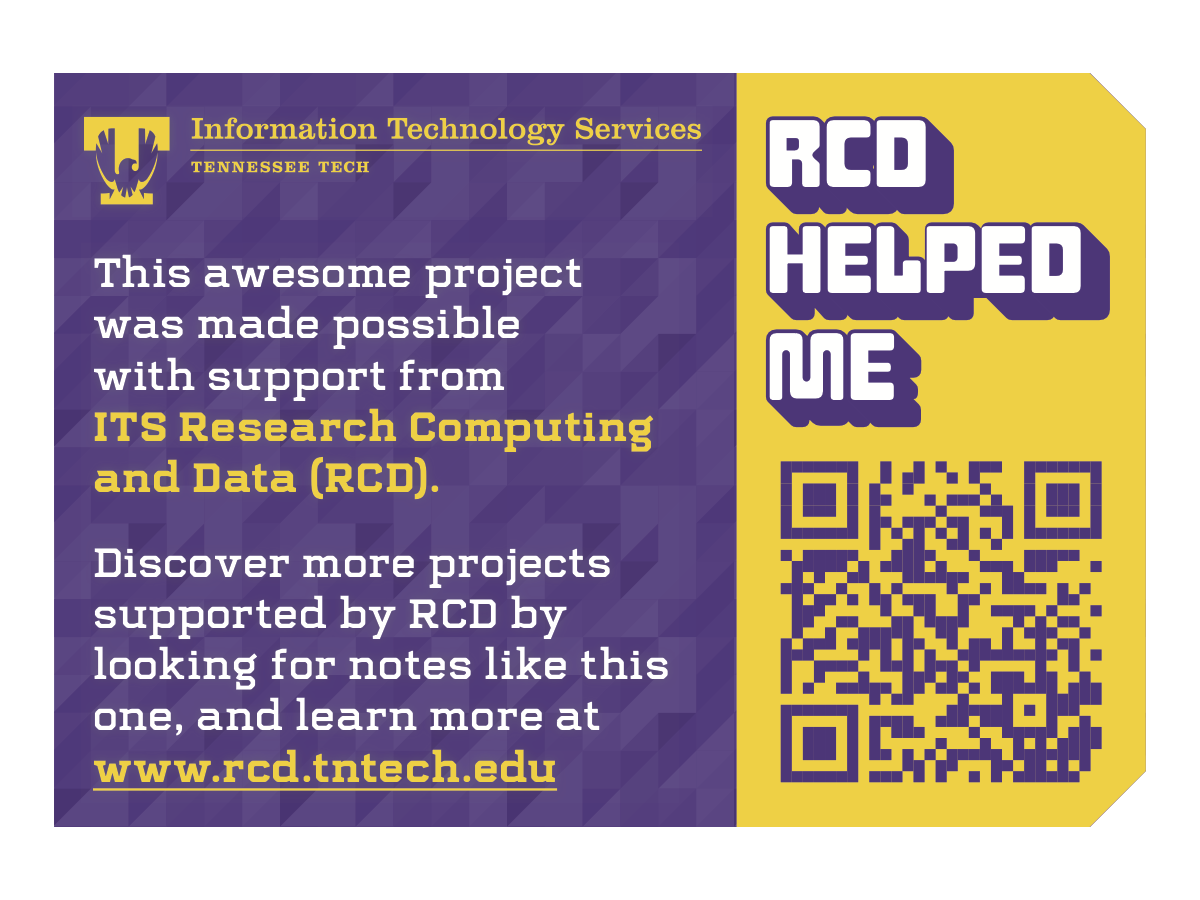
If you think RCD could help with your research needs, or would like to discuss the services we offer, you can find a short summary of who we are, what we do, and what resources we have here. Please also feel free to schedule a meeting with one of our crew to discuss how we can help.
Projects that RCD helped:
Evolutionary Mechanisms Shaping Chromosome Architecture in Fusarium
Authors: Salimi, Sahar
Advisors: Rahnama, Mostafa
Location: ASC-62
Abstract: The genus Fusarium comprises ecologically diverse filamentous fungi that include major plant and animal pathogens. One interesting observation is the association with horizontally acquired accessory chromosomes (ACs) and host-specific virulence. Although it plays a central role in shaping genomic architecture and virulence among species, karyotype evolution—changes in chromosome number, structure, and organization—remains poorly characterized in Fusarium. In this study, we investigate genome and karyotype evolution in Fusarium through comparative genomics, synteny analysis, and structural variant profiling using genomes from a set of species representing the breadth of phylogenetic diversity within the genus. Our work focuses on detecting and validating chromosome fusion and fission events, identifying conserved syntenic blocks, and examining the contribution of centromere dynamics and transposable elements to chromosomal rearrangements. Preliminary evidence from published Fusarium genomes indicates substantial variation in genome size, GC content, and TE composition, reflecting repeated cycles of genome expansion and compaction. Such processes, coupled with inter-centromeric recombination and segregation errors, are likely major drivers of karyotypic[RP1.1]. By integrating structural variation with phylogenetic analyses based on single-copy genes, we aim to elucidate evolutionary relationships that are not adequately resolved by sequence-based phylogenies alone. This research will generate a comprehensive assessment of chromosome-level evolution in Fusarium, providing insights into how genome dynamics influence adaptation, pathogenicity, and speciation. Understanding the mechanisms underlying karyotype diversification in Fusarium will not only enhance evolutionary and genomic frameworks for this complex genus but also support improved strategies for managing Fusarium-related diseases in agriculture and public health.